
In this Blog I plan to identify what systems thinking is and how it relates to Information Systems. Finally, I will address best practice in Systems Thinking Theory.
What is System Thinking?
A system, organic or man-made, is a group of individual components (functions or purpose) that interconnect and integrate with each other. They create a solution that has its’ own behavior.
Systems Thinking is the concept of addressing issues as a whole and not just individual parts. Behavior of all parts of a system are interconnected and interdependent, action on one part may cause a reaction elsewhere. In Systems Thinking, we identify the individual elements, foresee patterns, and know what the effects of change may be.
Sanford (2004) discusses a “hierarchy of system thinking types” (Bertalanffy & others):
- Closed Systems thinking– Limited access – limited ability to exchange energy with systems outside.
- Cybernetics Systems thinking– Computer based, replicating Human brain, independent of environment, works on feedback from its environment.
- Complex adaptive (Open) Systems thinking – tries to optimize a symbiotic relationship with the environment.
- Developmental systems thinking – addresses purpose, transformation and self-improvement and adding value.
- Evolutionary Systems Thinking – Looks at renewal, regeneration and new ways of working.”
This hierarchy advances from a degenerative (closed) to a regenerative (evolutionary) state.
System Thinkings relationship to the Information Systems field.
Acarolgu (2017) identified “6 Fundamental Concepts of Systems Thinking”:
Interconnectivity – Each element is reliant on something else.
Synthesis (combination of elements) – Seeing interconnectedness.
Emergence/Interactivity – Results created by synergetic elements.
Feedback Loops (Reinforcing & Balancing) – Over stimulation of one element can reinforce its growth or effect. Balancing is where one element counteracts with another to maintain a status-quo.
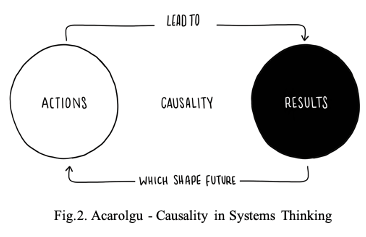
Causality – Understanding of cause and effect.
Mapping – Identifying and mapping the elements and understanding their interconnectivity and interdependency.
Batchmaster’s ERP Video outlines many aspects of Systems Thinking in retail.
The diagram below illustrates characteristics of the entire retail value chain and demonstrates how systems thinking can help drive growth, increase revenue, enhance customer service across wholesale, distribution and retail channels by mapping Acarolgus’ six fundamental elements.

As can be seen in the figure: Mapping(1) the individual elements shows the interconnectivity (2) and interdependencies in each part of the system. So, Purchasing input to Marketing on what customers should buy, so Marketing inputs to Sales (Stores) on what is selling. This leads to synthesis (3) of information from Sales & Marketing to drive instore Digital Signage systems. This in turn sees the emergence of interactivity (4) where promotions created by Marketing on the DS system drives sales and input to Purchasing. Sales increases drive feedback loops (5) to the Warehouse to put demand on the Supply chain. The whole system generates a causality (6) with higher Sales increasing income and potential profitability.
What are good practices of System Thinking theory?
Inquiry – Asking the right and different questions
Holistic Thinking – Thinking about the whole rather than just the individual parts.
Multiple Partial Views – Considering many of the individual parts of a systems.
Perspectives – POV of different departments or processes before taking decisions.
Prioritise – is the issue important?
History – Is the problem familiar/known?
Failure – has anyone tried unsuccessfully to solve it before?
(Lane, 2016) (Goodman, 2021)
Acaroglu, L. (2017, September 7). Tools of a System Thinker. Retrieved from medium.com: https://medium.com/disruptive-design/tools-for-systems-thinkers-the-6-fundamental-concepts-of-systems-thinking-379cdac3dc6a
Goodman, M. (2021, March 25). The Systems Thinker. Retrieved from Systems Thinker: https://thesystemsthinker.com/systems-thinking-what-why-when-where-and-how
Lane, A. (2016, April 6). Open University. Retrieved from Systems thinking and practice: https://www.open.edu/openlearn/ocw/mod/oucontent/view.php?id=3464&printable=1Sanford, C. (2004). Theory-Practice-of-Systems. Retrieved from Seed-Communities: https://seed-communities.com/wp-content/uploads/2015/02/Theory-Practice-of-Systems-Thinking.pdfvon Bertalanffy, L. (2010). General Systems Theory. In D. Hammond, The Science of Synthesis (pp. 103-142). Boulder: University Press of Colorado.
Batchmaster (2018) Retail ERP, https://www.youtube.com/watch?v=lmH3kucJrjY
Further Reading
Checkland, P. (1981). Systems Thinking Systems Practice.
Schuster, S. (2018). The Art of Thinking in Systems
Ollhoff, J. Walcheski, M. (2018). Making the Jump to Systems Thinking, https://thesystemsthinker.com/making-the-jump-to-systems-thinking/